
A Fair Value Gap (FVG) is a price inefficiency that forms when the market moves so aggressively in one direction that it skips over a section of price where normal two-sided trading did not take place. The result is a zone on your chart where buyers and sellers were not in balance, and the market will eventually return to rebalance it.
On a chart, an FVG appears within a three-candle structure. A large, aggressive middle candle creates a gap between the high of the first candle and the low of the third candle (bullish FVG), or between the low of the first candle and the high of the third candle (bearish FVG). The wicks of candles one and three do not fully overlap the middle candle. That visible space is the Fair Value Gap.
This is not the same as a regular price gap that appears in stocks after earnings or overnight sessions. A true FVG is caused by institutional order flow forcing price through levels faster than the market could fill orders on both sides. It is a precision tool, not a catch-all term for any space between candles.
In trading, FVG stands for Fair Value Gap. The strategy has gained traction among SMC and ICT traders because of its precision, its logical basis in institutional mechanics, and the fact that it appears consistently across all markets including forex, crypto, stocks, and indices.
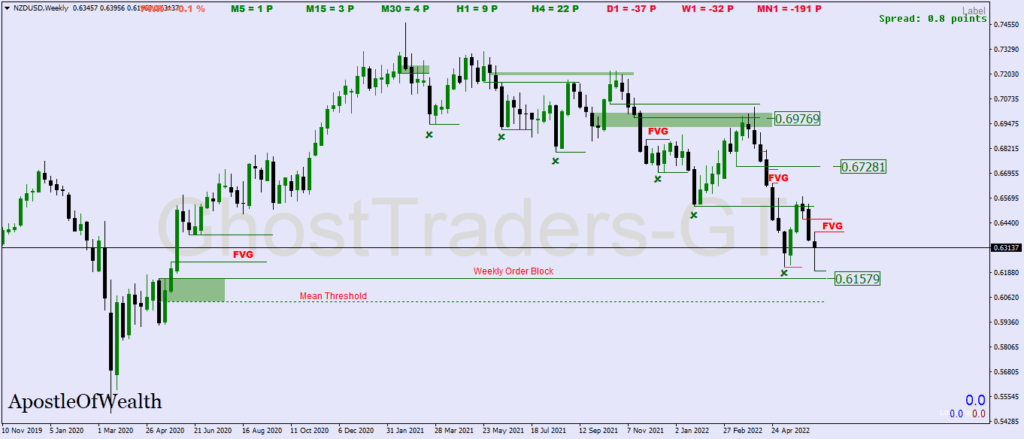
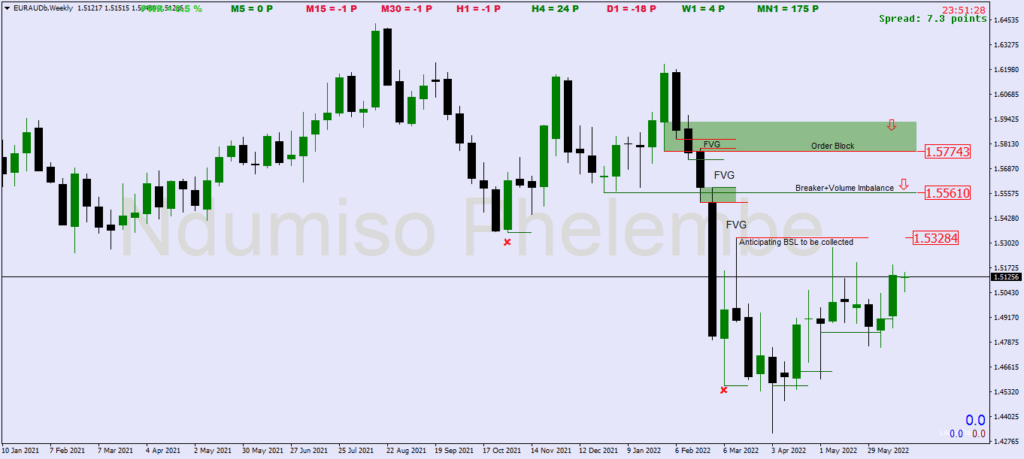
From The Chart Example, we can see how price declined significantly after closing our fair value gap. Based on the order flow being bearish, we can say this is a bearish fair value gap.
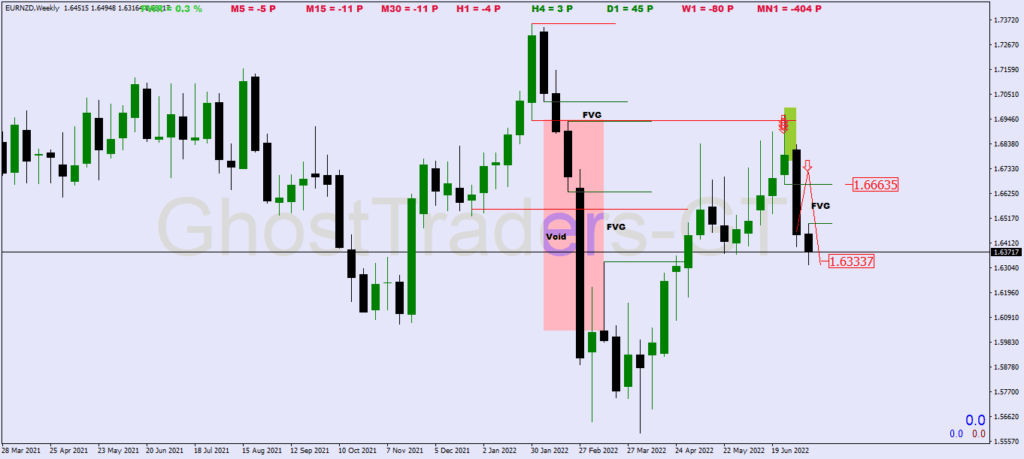
Price is most likely to reach out to areas where there are Fvg and Liquidity voids. The understanding of order flow trading should be coupled with fvg and liquidity void to select the best fair value gaps and liquidity voids.
Why FVGs Form: The Institutional Mechanics
FVGs are not random. They are the direct result of how institutions are forced to execute large orders in liquid markets.
Imbalance in Order Flow
When the market moves too quickly in one direction, certain price levels do not get traded as much. This creates a supply and demand imbalance at those specific levels. One side pushed aggressively and the other side did not have time to respond. The FVG is the visible scar that imbalance leaves on the chart.
Liquidity Hunting
Institutions deliberately create imbalances to trap retail traders and collect liquidity before making their actual move. FVGs are frequently byproducts of these liquidity sweeps. The institution runs stops above a high or below a low, collects the liquidity it needs to fill its position, and the aggressive move away from that level leaves a gap behind.
Algorithmic Efficiency
The market operates on algorithms designed to seek and fill inefficiencies. Once an FVG is created, the algorithm treats it as an area requiring rebalancing. This is why price gravitates back to these zones so reliably. It is not traders predicting behaviour. It is the market doing what its programming dictates.
Urgency in Execution
Large institutional orders are executed with urgency to avoid slippage and front-running. This urgency causes price to leap from one level to another without proper fill, which is exactly what creates the gap structure you see on the chart.
Imbalance vs Inefficiency: What Is Actually Happening
There is an ongoing argument in the SMC community about whether an FVG is an “imbalance” or an “inefficiency.” The answer is both, and they are not separate things. They are cause and effect.
When you see a strong move that creates an FVG, what you have is a supply and demand imbalance. One side pushed aggressively and the other did not have time to respond. That imbalance between supply and demand is the cause. The inefficiency you see on your chart, the visible gap, is the effect.
It is worth noting that this is not about the number of buy and sell orders. Every buy order must be matched with a sell order to fill. What creates an FVG is when buyers or sellers become more aggressive than the other side, forcing price to move faster than the market can offer orderly fills on both sides.
Understanding this cause-and-effect relationship stops you from chasing every three-candle structure you see. The question you should always ask is: what caused this gap? Was there institutional aggression here, or just a normal swing candle?
Types of Fair Value Gaps
Not all FVGs are created equal. The type of FVG determines its strength, its likely behaviour, and how you should trade it.
Bullish Fair Value Gap
A bullish FVG forms during an aggressive upward move. The gap appears between the high of the first candle and the low of the third candle. This gap suggests that buyers overwhelmed sellers, creating an imbalance to the upside. When price retraces into this gap, it typically finds support and reacts higher, continuing the uptrend. To identify the highest quality bullish FVG, look for it below the discount level of your defined range using Fibonacci levels.
Bearish Fair Value Gap
A bearish FVG forms during an aggressive downward move. The gap appears between the low of the first candle and the high of the third candle. This gap signals that sellers dominated buyers and created a downside imbalance. When price retraces into this gap, it typically finds resistance and drops lower, continuing the downtrend. The highest quality bearish FVG sits at or above the premium level of your defined range using Fibonacci levels.
Displacement FVG
Displacement FVGs occur during extremely volatile moves where price makes a sudden, violent shift in direction. These gaps are larger and more pronounced than standard FVGs and carry greater significance because they represent a decisive shift in market sentiment and order flow. They are found at the start of major trends or following significant news events. A displacement FVG signals that smart money entered aggressively and that market structure has fundamentally changed. These are the highest conviction FVGs on the chart.
Breakaway Fair Value Gap
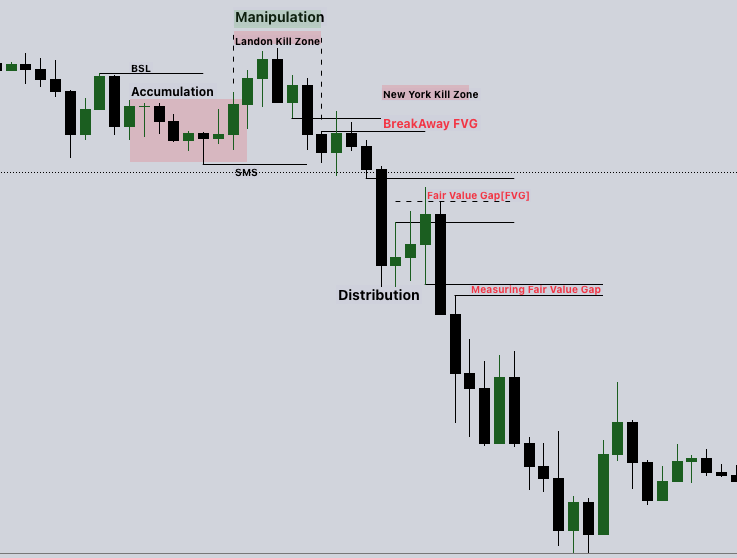
A Breakaway FVG forms when price escapes a consolidation zone or trading range with a surge in momentum. It signals that one side decisively broke the equilibrium. In a bullish breakaway gap, price clears a resistance level with aggressive momentum, signalling that buyers have taken control. These gaps reflect changing market dynamics and their persistence tells you the move is being driven by genuine institutional intent, not a temporary spike.
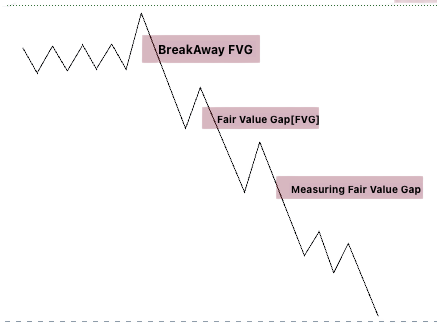
Measuring Fair Value Gap
The Measuring FVG forms following an initial displacement FVG and tends to remain open. Its persistence happens because heavy institutional order flow surrounds it, keeping price moving consistently in one direction. Unlike standard FVGs which get filled on retracements, Measuring FVGs act as a directional signal. A bearish Measuring FVG in the middle of a downtrend signals that institutional sellers are so dominant that price does not need to retrace. When you see one, respect the trend and do not look for counter-trend entries at that level.
In summary, the Measuring Fair Value Gap serves as a valuable tool for traders to identify and interpret institutional order flow. Its persistence and direction provide valuable insights into the prevailing market sentiment, helping traders make more informed decisions.
Market Structure First: Why Context Beats Everything
Before you touch a single FVG on your chart, you need market structure. No exceptions.
FVGs do not exist in isolation. A gap without structure is just a gap. What turns it into a tradeable setup is the context around it.
Start by identifying the trend on your trading timeframe. Look for the Break of Structure (BOS) where price closed beyond a key high or low. Then track the Change of Character (CHoCH), which is the first sign that the dominant trend is shifting. Once you have that map, your bias is set.
If the structure is bullish, meaning higher highs and higher lows with BOS moves to the upside, you only want bullish FVGs. If structure is bearish, meaning lower highs and lower lows, you only want bearish FVGs. The only exception is when you are trading a confirmed CHoCH, because that is a potential reversal point where the market is genuinely changing direction.
Structure first. FVG second. Always.
How to Identify Fair Value Gaps on Your Chart
Step 1: Look for Aggressive Three-Candle Moves
Scan your chart for areas where three consecutive candles form with a sharp, impulsive middle candle. The first and third candles should not overlap in their wicks or bodies, creating a visible space on the chart. This space is the gap.
Step 2: Measure the Gap
For a bullish FVG, measure from the high of candle one to the low of candle three. For a bearish FVG, measure from the low of candle one to the high of candle three. Mark these levels clearly. The midpoint of this zone, the 50% level, is called the Consequent Encroachment (CE) level and plays a critical role in entry timing.
Step 3: Confirm the Timeframe
FVGs appear on all timeframes, but not all are equally significant. Higher timeframe FVGs on the 4-hour, daily, and weekly charts carry more institutional weight and are more reliable. Lower timeframe FVGs produce more noise. Use higher timeframes to identify the primary FVG and lower timeframes to time your entry.
Step 4: Check Market Structure
Apply the four rules. Is the FVG with the trend? Did it trigger a BOS or CHoCH? Does it sit in premium or discount? Is it unmitigated? If all four are yes, you have a valid setup worth marking.
How to Trade the Fair Value Gap Strategy
Order Flow Bias First
Establish your directional bias before you look at a single FVG. Look at the daily chart first to understand the macro order flow. If it is not clear on the daily, step to the 4-hour and 1-hour charts. Your bias determines which type of FVG you are looking for. Trading a bullish FVG in bearish order flow is low probability regardless of how clean the gap looks.
Wait for Price to Return to the Gap
Once you have a valid FVG marked, wait. Do not enter as soon as you identify it. Price needs to retrace into the gap zone. Let it come to you. The market always revisits inefficiencies. Patience is not optional in this strategy. It is the strategy.
Look for Confirmation on a Lower Timeframe
When price enters your FVG zone, drop to a lower timeframe and look for confirmation. You are looking for a bullish or bearish Change of Character on that lower timeframe, or a clear rejection candle forming inside the gap zone. This confirmation is what separates a disciplined entry from gambling on a gap fill.
Entry, Stop Loss, and Take Profit
Enter within the FVG zone once confirmation appears. Place your stop loss just beyond the FVG:
- For bullish setups: stop below the low of the FVG zone.
- For bearish setups: stop above the high of the FVG zone.
For take-profit, target the next significant area of interest: nearby liquidity pools, previous highs or lows, or the next significant order block level. If the move aligns with a larger trend, use a trailing stop to maximise the return.
Reversal Trading with Fair Value Gaps
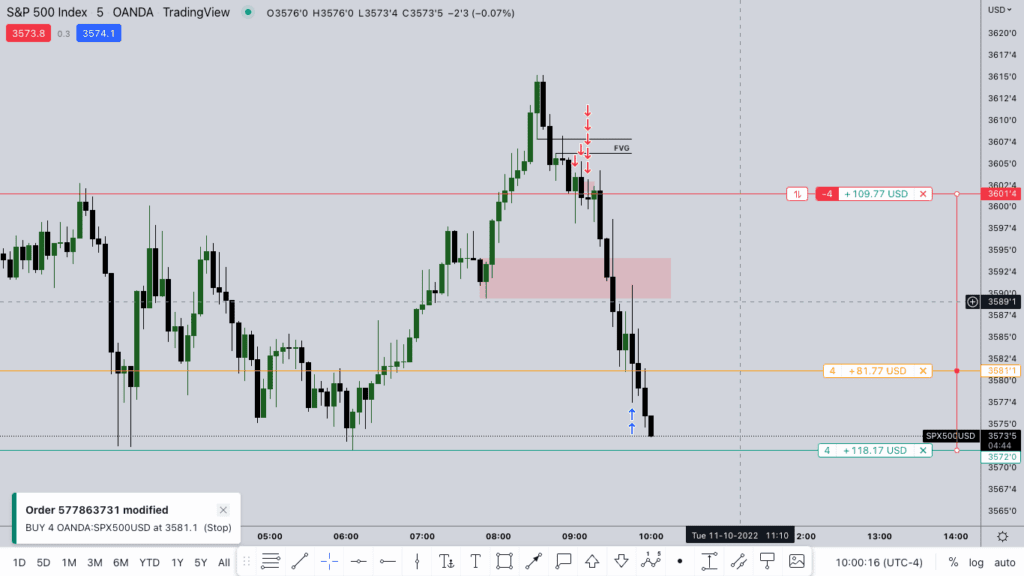
One of the most common strategies involving FVGs is reversal trading. When price collects sell-side or buy-side liquidity, traders anticipate either a reversal, retracement, or continuation. In reversal trading, the focus is on using a fair value gap as the entry point.
Sell Setup: When price collects buy-side liquidity (BSL), anticipate a reversal. Wait for a shift in market structure to confirm the anticipated reversal, then look for a fair value gap and use it as an entry point to sell short.
Buy Setup: When price collects sell-side liquidity (SSL), anticipate a reversal. Wait for a shift in market structure to confirm, then look for a fair value gap and use it as an entry point to buy or enter long.
Consequent Encroachment (CE) and IOFED
Consequent Encroachment
These are two concepts that most FVG guides simply do not cover. They are also two of the most practically useful ideas for entry timing.
Consequent Encroachment (CE)
Consequent Encroachment is when price fills a fair value gap by exactly 50%. This 50% level is called the Mean Threshold of the FVG. In practice, price does not always fill the entire gap before reacting. Targeting the mean threshold rather than the full bottom or top of the gap keeps you in trades that might otherwise stop you out before the reaction occurs. Set limit orders at the CE level rather than waiting for a full gap fill.
Institutional Order Flow Entry Drill (IOFED)
IOFED stands for Institutional Order Flow Entry Drill. It describes the situation where price retraces into a Fair Value Gap but reverses before reaching the 50% midpoint. Institutional order flow is so dominant in one direction that the market does not even need to fill half the gap before continuing the original move.
This matters because it creates an earlier and often cleaner entry than waiting for CE or a full fill. When you see price enter your FVG zone and reject immediately before reaching the midpoint, that is your IOFED signal. The rejection before CE is a sign of strength in the original direction. If price fills toward the middle zone and holds at the CE level, you have a standard Consequent Encroachment setup.
Both are valid. IOFED gives earlier entry. CE gives more confirmation. Use the structure of the price action inside the gap to decide which applies.
FVG Mitigation vs. Invalidation
Knowing the difference between these two outcomes determines whether you stay in a trade or cut it.
Mitigation is when price enters the FVG zone and institutions execute their pending orders in that area. Price shows a reaction at this point, either reversing or continuing based on the new balance of orders. A mitigated FVG has done its job. The gap has been used up. Do not look for a second trade from the same zone.
Invalidation is when price fills the gap completely and continues strongly against your directional bias. The gap no longer offers the liquidity imbalance it once did. Once invalidated, the FVG loses its predictive power entirely. If price blows through the bottom of a bullish FVG on volume and keeps going, do not hold the trade hoping for a reversal. The institutional thesis is broken. Exit.
The practical rule: if price closes a full candle body beyond the FVG boundary in the wrong direction, the gap is invalidated. Mitigated means it worked. Invalidated means it did not. Treat them differently.
How Long Are Fair Value Gaps Valid?
There is no time-based expiration on Fair Value Gaps. They remain valid until price returns and fills them. The market operates on liquidity, not clocks.
That said, context matters. A fresher FVG carries more weight than one formed months ago in a completely different structural environment. If the market has shifted dramatically since the gap formed, and the structure that created the gap is no longer relevant, treat the gap with less conviction even if it is technically unfilled.
As a practical guide: FVGs formed within the current trend structure carry full weight. FVGs from previous trend structures should be treated with caution unless price is returning to them in the context of a clear retracement.
FVGs as Targets, Not Just Entries
Most traders only think about FVGs as entry points. They are just as powerful as targets.
If price is drawn to imbalances, it makes perfect sense to use untouched bearish FVGs above price as targets for bearish trades, and unfilled bullish FVGs below price as targets for bullish trades. This is especially powerful in multi-timeframe analysis where a higher-timeframe FVG sits at a logical termination point for a lower-timeframe move.
Using FVGs as targets gives you:
- Structure-based exits that are rooted in the same logic as your entry
- Cleaner risk-to-reward ratios because your target has a reason to hold
- Less emotional decision-making because you know exactly where you are going before the trade begins
Older, unfilled FVGs, sometimes called Inverse FVGs when they have flipped character, make particularly strong targets because the market has been drawn toward them for longer. The pull is greater.
Fair Value Gaps and Order Blocks: The Highest-Probability Setup
An Order Block without a Fair Value Gap is significantly weaker. An FVG without an Order Block has no confirmed origin. Together, they produce the most reliable setups in the SMC framework.
An Order Block is the last opposing candle before a strong directional move that breaks market structure. A Fair Value Gap is the imbalance left by that move. When the FVG sits directly inside or in front of an order block, you have institutional confirmation at the same price level from two different angles.
Here is how the relationship works in practice:
The order block marks where institutions placed their orders. The FVG confirms that the move away from that level was genuinely institutional in nature, not just a retail spike. When price returns to the zone, it encounters both the unfilled OB orders and the gap imbalance at the same location. This confluence is what pushes win rates significantly higher compared to either concept traded in isolation.
The trade sequence:
- Identify the order block (last opposing candle before a BMS move).
- Confirm the FVG is present between the OB and the point where price is now.
- Wait for price to retrace into the OB and FVG overlap zone.
- Look for lower-timeframe confirmation (CHoCH or rejection candle).
- Enter, with stop beyond the OB boundary and target at the next liquidity level.
If there is no FVG accompanying the order block, the block should be treated with significantly less confidence. The FVG is the validator.
The Four Rules for High-Probability FVGs
These four rules filter out the noise and put you in front of setups that actually have institutional logic behind them.
Rule 1: Trade With the Trend
If the trend is up, you want bullish FVGs on pullbacks. If the trend is down, you want bearish FVGs on retracements. The only exception is a confirmed CHoCH where you are anticipating a directional shift. An FVG against the trend is not a setup. It is a trap.
Rule 2: The FVG Must Trigger a BOS or CHoCH
You need displacement. The FVG must have been part of a move that broke something meaningful, either an external high or low (BOS) or a change of character. FVGs that form inside consolidation without triggering a structural break are internal noise. They show up on your chart but they carry no institutional weight.
Rule 3: Use the Premium and Discount Filter
This is one of the most underused filters in FVG trading and one of the most powerful. Draw a Fibonacci retracement from the most recent significant swing low to the most recent significant swing high (or vice versa in a downtrend). The 50% level divides the range into premium (above 50%) and discount (below 50%).
In an uptrend, only buy FVGs in the discount zone (below 50%). You are buying at a relative low, which is where institutions enter, not retail traders chasing highs.
In a downtrend, only sell from FVGs in the premium zone (above 50%). You are selling at a relative high.
This single filter removes a significant number of poor setups and forces you into positions where your risk-to-reward is naturally better because you are entering from a logical point in the price structure.
Rule 4: One-Time Use Only
An FVG is a one-time use area. Once price trades back into it and fills the imbalance, the setup is done. A mitigated FVG is no longer a high-probability entry because the liquidity that made it relevant has already been consumed. Do not attempt to trade the same gap twice. Mark it as mitigated and move on to the next valid setup.
Fair Value Gaps vs Liquidity Voids
These terms are related but not interchangeable, and mixing them up will cost you precision.
A Liquidity Void is any area on the chart where price moved rapidly in one direction, forming large candlesticks with minimal trading activity on either side. The market tends to revisit and fill these areas over time.
A Fair Value Gap is a specific type of liquidity void defined by the exact three-candle pattern. All FVGs are liquidity voids, but not all liquidity voids qualify as FVGs.
The practical difference: FVGs give you a precise entry zone defined by specific candle boundaries. Liquidity voids are larger, less defined areas where the overall price imbalance exists but without the specific reference points needed for tight entry and stop placement.
When building confluence, use both. A liquidity void tells you the direction price is likely to travel. An FVG within that void gives you the specific level to trade from.
Reversal Trading with Fair Value Gaps
The most common FVG strategy is continuation, meaning trading with the trend when price retraces into a gap. But FVGs are equally powerful for reversal setups when combined with liquidity sweeps and market structure shifts.
Sell Reversal Setup
Price collects buy-side liquidity (BSL) by sweeping above a recent high. This triggers stop losses from short sellers and gives institutions the liquidity they need to enter short. Once the sweep occurs, wait for a market structure shift to confirm the reversal. Then look for a bearish FVG formed during the sweep move and use it as your entry point for the short trade.
Buy Reversal Setup
Price collects sell-side liquidity (SSL) by sweeping below a recent low, triggering stop losses from buyers. Once the sweep is complete, wait for market structure to shift bullish. Then find the bullish FVG formed during the sweep and use it as the entry for the buy trade.
The key to reversal FVG trading is the liquidity sweep happening first. Without the sweep, you are not trading a reversal. You are guessing a top or bottom. Wait for the sweep, confirm the shift, then enter the FVG.

Common Mistakes Traders Make with FVGs
Trading every gap they see
The single most expensive mistake. Most FVGs on your chart are noise. Without the four validation rules in place, you are random-entry trading dressed up as a strategy.
Ignoring the premium and discount filter
Buying FVGs in premium or selling FVGs in discount puts you on the wrong side of the price delivery algorithm. You are buying high and selling low while calling it smart money trading.
Using mitigated FVGs
Once a gap is filled, its edge is gone. Traders who mark a gap and return to it days later after it has already been filled are trading a zone with no remaining institutional relevance.
Trading against the trend
A counter-trend FVG is not a reversal setup unless you have a confirmed CHoCH. Without that confirmation, you are trading against momentum with no structural justification.
Entering without lower-timeframe confirmation
Jumping into the gap zone without a lower-timeframe CHoCH or rejection candle is premature. You need confirmation that institutions are actually defending the gap level before you commit capital.
Dropping straight to low timeframes
If you skip the higher timeframe analysis and go straight to a 5-minute chart looking for FVGs, you will find dozens of them, most of them meaningless. Always start at the top and work down.
Relying on an indicator without understanding the concept
An FVG indicator is a tool, not a strategy. If you do not understand why a gap forms and why price returns to it, you cannot make good decisions when price behaves unexpectedly inside the zone.
The FVG Trade Checklist
Before entering any FVG trade, run through this checklist. Every item should be yes before you touch the button.
- Is the FVG aligned with the current trend direction or a confirmed CHoCH reversal?
- Did this FVG trigger a BOS or CHoCH at an external high or low?
- Is the FVG sitting in discount (for buys) or premium (for sells) based on Fibonacci?
- Is the FVG fresh and unmitigated?
- Is there an order block at or near the same level adding confluence?
- Is there a lower-timeframe CHoCH or rejection candle forming inside the zone?
- Is your stop placement clearly beyond the gap boundary?
- Is your target at the next significant liquidity level with at least 2:1 risk-to-reward?
If you cannot check all of these, the setup is not ready. Wait for the next one.
Frequently Asked Questions
What is a Fair Value Gap in simple terms?
A Fair Value Gap is a three-candle pattern where price moves so aggressively that it leaves a price zone where normal two-sided trading did not happen. Markets return to these zones to rebalance the inefficiency. In SMC terms, it is the visible evidence that institutions entered the market aggressively at that point.
Do Fair Value Gaps always fill?
Not always, but the majority do. The market is a liquidity-seeking mechanism and FVGs represent exactly the kind of unfilled order pockets that draw price back. The exceptions are usually Measuring FVGs in strong trending conditions, where institutional momentum is so one-sided that the rebalancing is postponed indefinitely. Freshness matters: newer FVGs in active trend structures fill more predictably than older ones in changed market conditions.
What is the difference between a bullish FVG and a bearish FVG?
A bullish FVG forms when price rises too fast, leaving a gap below where buying pressure was so strong it skipped price levels. Price is expected to return to this zone and find support before continuing higher. A bearish FVG is the opposite: price dropped too fast, leaving a gap above where selling pressure was dominant. Price returns to find resistance before continuing lower.
What is the best timeframe for trading Fair Value Gaps?
The 4-hour and daily charts produce the most reliable FVGs because the gaps represent genuinely significant institutional moves rather than intraday noise. Use the 1-hour chart for refining your entry timing. Use the 15-minute or 5-minute chart for the lower-timeframe CHoCH confirmation inside the zone. Never start your analysis on a low timeframe and work up. Always start high and work down.
What is Consequent Encroachment?
CE is the 50% midpoint of a Fair Value Gap. It is the most logical entry level within the gap because it gives you the best possible risk-to-reward while still keeping you inside the institutional zone. Price may not fill the entire gap, so using the CE as your limit order entry keeps you in setups that would otherwise stop you out if you waited for a full fill.
What is IOFED?
IOFED stands for Institutional Order Flow Entry Drill. It is when price enters a Fair Value Gap but reverses before reaching the 50% CE level, showing that institutional momentum is so strong in the original direction that the market barely needs to retrace before continuing. IOFED setups provide earlier and often more aggressive entries than CE setups.
Are FVGs better than order blocks?
They serve different purposes and are most powerful when combined. FVGs show where price moved too fast, leaving an imbalance. Order blocks show where institutions placed their orders before that fast move. An FVG validates an order block. An order block provides the origin context for an FVG. Trading them together produces the highest-probability setups in the SMC framework.
Does the Fair Value Gap strategy work in crypto and stocks?
Yes. The mechanics behind FVGs, institutional order flow creating price imbalances, apply to any liquid market. Crypto, indices, commodities, and forex all exhibit FVG behaviour. In crypto, higher timeframes tend to produce cleaner gaps because lower timeframes are more fragmented. In stocks, be aware that gaps around earnings or major news can look like FVGs but are driven by fundamental catalysts rather than pure institutional accumulation.
What is an Inverse Fair Value Gap (IFVG)?
An Inverse FVG is a standard FVG that price has broken through in the wrong direction. Once price moves beyond the boundaries of a gap and continues, the gap flips character. A bullish FVG that gets broken to the downside can become a resistance zone, functioning as an IFVG. These flipped zones are useful as targets for continuation trades in the new direction.
Conclusion
Fair Value Gaps are one of the most powerful tools in the price action trader’s toolkit. They reveal where institutions were aggressive, why price will return to specific zones, and precisely where to position entries with logical stop placements and clear targets. But they only work when you approach them with structure, context, and discipline.
The formula is threefold.
First, identification: locate valid three-candle gaps where the wicks of candle one and three do not overlap. Classify the type: bullish, bearish, displacement, breakaway, or measuring.
Second, context: apply the four rules without exception. Trend alignment, structural confirmation, premium and discount filtering, and mitigation status. Skip any one of these and you are placing capital on a lower-probability event.
Third, execution: enter on lower-timeframe confirmation, set your stop beyond the gap boundary, and target the next liquidity level with at least 2:1 reward. Manage the trade with CE and IOFED in mind so you are prepared for both early rejections and full fills.
The market leaves clear evidence of where it has been and where it is likely to go. Fair Value Gaps are some of the clearest evidence available. Master them, respect the rules, and you will trade with the flow of institutional money rather than against it.
Glossary
| Term | Definition |
|---|---|
| Fair Value Gap (FVG) | A three-candle price imbalance where the wicks of candles one and three do not overlap the middle candle, creating a zone of institutional activity that price is drawn back to fill. |
| Bullish FVG | A gap formed during an aggressive upward move, with the space existing below the middle candle. Acts as a support zone on retracement. |
| Bearish FVG | A gap formed during an aggressive downward move, with the space existing above the middle candle. Acts as a resistance zone on retracement. |
| Displacement FVG | A large, aggressive FVG formed by a violent shift in sentiment, often found at the start of major trends. Highest conviction gap type. |
| Breakaway FVG | An FVG that forms as price escapes a consolidation zone with a surge in momentum and volume. |
| Measuring FVG | An FVG that forms mid-trend and tends to remain open due to dominant one-sided institutional flow. Used as a directional signal rather than a retrace entry. |
| Consequent Encroachment (CE) | The 50% midpoint of an FVG, used as the optimal limit order entry level within the gap zone. |
| IOFED | Institutional Order Flow Entry Drill. When price enters an FVG but reverses before reaching the CE level, signalling dominant institutional momentum in the original direction. |
| Mitigation | When price returns to an FVG and fills the imbalance. The gap is now “used up” and no longer valid for further entries. |
| Invalidation | When price breaks completely through an FVG in the wrong direction, eliminating its predictive value. |
| Inverse FVG (IFVG) | A previously valid FVG that has been broken through and flipped character, now acting as a zone of resistance or support in the opposing direction. |
| Premium | Price above the 50% Fibonacci level of a defined range. Institutional selling zone. |
| Discount | Price below the 50% Fibonacci level of a defined range. Institutional buying zone. |
| Break of Structure (BOS) | When price closes beyond a previous external swing high or low, confirming the trend direction. |
| Change of Character (CHoCH) | The first break of structure in the opposite direction, signalling a potential trend reversal. |
| Liquidity Void | Any area of rapid, one-sided price movement with minimal trading activity on both sides. All FVGs are liquidity voids, but not all liquidity voids are FVGs. |
| Order Block (OB) | The last opposing candle before a strong directional move that breaks market structure. FVGs validate order blocks. |
Hey, Check Our Instagram account and stay updated.
