

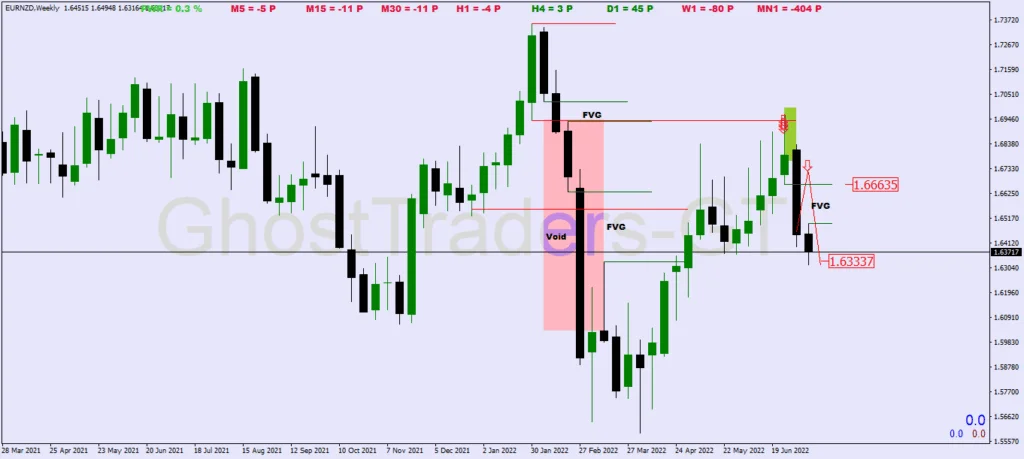
Liquidity voids are one of the clearest signs of institutional aggression on a chart. When price moves so fast that it skips over an entire price range without any meaningful two-sided trading, it leaves behind a void. That void is not just a visual gap. It is the evidence that smart money entered at size, pushed price away from a level with force, and left an inefficiency the market will eventually return to fill.
Understanding liquidity voids gives you two things. First, a directional signal: price moved aggressively in one direction, which tells you where institutional momentum is pointing. Second, a retracement target: the void itself becomes the zone price is drawn back to before continuing. Both matter for building a complete trade.
What Is a Liquidity Void?
A liquidity void is any area on a chart where price moved so rapidly in one direction that little to no two-sided trading occurred across that price range. On a candlestick chart, it appears as one or more large-bodied candles with minimal wicks, covering significant ground quickly and leaving behind a zone where the market essentially skipped price levels.
The word “void” is accurate. That section of the price range is empty of meaningful order matching. Buyers and sellers did not transact efficiently across those levels because one side moved so aggressively that the other side never had a chance to respond. The market algorithm treats that void as an inefficiency and draws price back to rebalance it at some point.
In ICT terminology, a liquidity void is produced by displacement. Displacement is the aggressive, institutional-grade price expansion that occurs after a liquidity event such as a sweep of BSL or SSL. The two concepts are inseparable: the liquidity event is the cause, and the void is the effect left behind.
Liquidity voids are broader and less structurally precise than fair value gaps. They represent the overall zone of imbalance. Fair value gaps are the specific three-candle patterns sitting inside that zone. Both are relevant to trading, but they serve different roles, which is covered in detail in the next sections.
How Liquidity Voids Form: Displacement and Institutional Aggression
Liquidity voids do not form from normal price movement. They require institutional aggression: a large, directional order flow event where smart money enters the market with enough force to push price through multiple levels without waiting for orderly fills on both sides.
The sequence that creates a void is consistent:
Step 1: Liquidity is collected. Price sweeps a BSL pool above a swing high or an SSL pool below a swing low. Stop losses trigger and institutions fill their positions using those orders as counterparty.
Step 2: Displacement occurs. With the position now filled, institutional order flow pushes price aggressively in the real direction. The move is fast, decisive, and covers significant ground in a short number of candles. This is the displacement.
Step 3: The void is left behind. The speed and aggression of the displacement means price did not trade efficiently across the range it covered. That range becomes the liquidity void. No meaningful consolidation, no wick-to-wick overlap between candles, just a clean directional expansion.
Step 4: Price is drawn back. The market algorithm is designed to seek balanced price delivery. The void represents unfinished business, specifically price levels that were skipped over without proper two-sided participation. Eventually, price retraces into the void to rebalance those levels before making the next directional move.
This sequence is why liquidity voids are tradeable. They are not random gaps. They are the direct consequence of institutional positioning, and the retracement that fills them is the predictable consequence of the algorithm seeking balance.
Bullish vs Bearish Liquidity Voids
Bullish Liquidity Void
A bullish liquidity void forms when price moves aggressively upward, leaving behind a zone below where trading did not occur properly. The void sits below current price. It was created by institutional buying that drove price up too fast for sellers to match orders at every level along the way.
When price retraces downward later, it is drawn toward this void. The void acts as a support zone because it contains unmitigated price levels the market needs to revisit. Traders use the retracement into a bullish void as a buy opportunity, expecting price to find support there and resume higher.
On the chart: Look for one or more large bullish candles with small or no wicks, covering ground quickly. The zone between the bottom of the first expansion candle and the close of the last candle in the move represents the void.
Bearish Liquidity Void
A bearish liquidity void forms when price moves aggressively downward, leaving a zone above where trading did not occur properly. The void sits above current price. It was created by institutional selling that drove price down too fast for buyers to match orders at every level.
When price retraces upward later, it is drawn toward this void. The void acts as a resistance zone because it contains unmitigated levels the market must revisit before continuing lower. Traders use the retracement into a bearish void as a sell opportunity.
On the chart: Look for one or more large bearish candles with small or no wicks, dropping sharply. The zone between the top of the first expansion candle and the close of the last candle in the move represents the void.
Liquidity Voids vs Fair Value Gaps: The Real Distinction
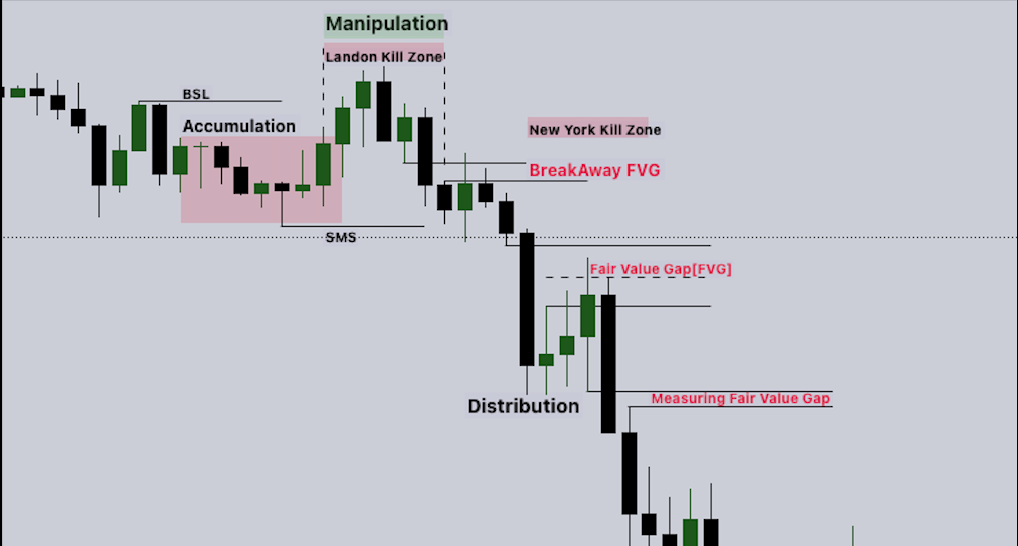
This is the most important distinction to understand because the two terms are frequently used interchangeably when they should not be.
A liquidity void is the broader zone of imbalance created by displacement. It spans the entire range that price moved through too aggressively. It may contain multiple candles and cover a wide price range. All FVGs are liquidity voids, but a liquidity void is not always a single FVG.
A fair value gap is a specific three-candle pattern sitting within that void. The FVG is defined by the precise gap between the wick of candle one and the wick of candle three, where candle two is the aggressive displacement candle. It gives you exact boundaries: a top and a bottom of the gap, and a 50% midpoint called the Consequent Encroachment level.
Feature | Liquidity Void | Fair Value Gap |
|---|---|---|
Scope | Broad zone, often multiple candles | Precise three-candle pattern |
Boundaries | General range of the displacement | Exact wick-to-wick measurement |
Entry precision | Lower, wider zone | Higher, specific levels for entry |
Identification | Look for large directional candles | Look for the wick gap between candles 1 and 3 |
Use in trading | Direction signal and broad target zone | Precise limit order entry level |
Relationship | Parent concept | Specific form of a liquidity void |
The practical application: Use the liquidity void to understand the directional context and identify the general zone price will return to. Then look for the specific FVG within that void to get your precise entry level. The void tells you where to look. The FVG tells you exactly where to enter.
For a complete breakdown of how to trade fair value gaps precisely, including CE, IOFED, and the four validation rules, the GhostTraders guide on fair value gap trading strategy covers the full methodology.
How to Identify a Liquidity Void on Your Chart
Step 1: Look for displacement candles. Scan for areas where one or more large-bodied candles moved in one direction with minimal wicks. The body-to-wick ratio matters: a candle that is 90% body with tiny wicks represents aggressive, one-sided order flow. Multiple candles stacked in the same direction without consolidation between them form a stronger void.
Step 2: Confirm a liquidity event preceded it. A valid displacement void follows a liquidity sweep or grab. Check whether price swept a swing high (BSL taken) before a bearish void, or a swing low (SSL taken) before a bullish void. Without the liquidity event, the displacement is weaker and the void carries less institutional weight.
Step 3: Measure the void boundaries. Mark the top and bottom of the displacement range. For a bullish void, the bottom of the void is the open of the first aggressive bullish candle. The top is the close of the last candle in the expansion move. For a bearish void, reverse this: the top is the open of the first aggressive bearish candle, the bottom is the close of the last.
Step 4: Identify FVGs within the void. Look inside the measured void range for the three-candle FVG pattern. In most displacement moves, at least one FVG forms within the void. This is your entry zone. If multiple FVGs form, prioritise the one closest to the origin of the displacement for the strongest reaction.
Step 5: Confirm with market structure. The void must have triggered a Break of Structure (BOS) or a Change of Character (CHoCH). If the displacement move did not break a significant structural level, the void is weaker and the retracement may not produce a strong reaction.
How to Trade Liquidity Voids Step by Step
Step 1: Establish Higher Timeframe Bias
Before entering any trade from a liquidity void, confirm the directional bias on the 4-hour or daily chart. A bullish void should be traded in a broader bullish structure. A bearish void should be traded in a broader bearish structure. Trading a void against the higher timeframe trend requires a confirmed CHoCH reversal to justify the entry.
Step 2: Identify the Void and Wait for the Retracement
Mark your void on the chart using the steps above. Do not enter when the displacement is occurring. The trade happens on the retracement back into the void, not during the initial move. Let price make its impulse, pull back, and begin to retrace toward the void zone. Patience here is not optional.
Step 3: Find the FVG Entry Within the Void
As price retraces into the void, identify the specific FVG within it. Set a limit order at the Consequent Encroachment level (the 50% midpoint of the FVG). This gives you the tightest possible entry with the best risk-to-reward ratio while keeping you inside the institutional zone.
Step 4: Confirm on a Lower Timeframe
When price enters the void and approaches your FVG, drop to a lower timeframe (one or two levels below your working chart). Look for a Change of Character confirming that the retracement is ending and the original direction is resuming. A bullish CHoCH inside a bullish void confirms a long entry. A bearish CHoCH inside a bearish void confirms a short entry.
Step 5: Set Stop Loss and Target
Place your stop loss beyond the boundary of the void. For a long trade from a bullish void, the stop goes below the bottom of the void. For a short trade from a bearish void, the stop goes above the top of the void. Do not place the stop inside the void because price may fluctuate across the full void range before reacting.
Your target is the next significant liquidity level. If trading a bullish void retracement, target the BSL pool above or the next external range liquidity. If trading a bearish void retracement, target the SSL pool below. Minimum target is 2:1 risk-to-reward. Well-structured void setups frequently deliver 3:1 or better when you let them run.
Step 6: Manage the Trade
Move stop to break even once price reaches 1R in your favour. After that, allow the trade to run toward the target. Institutional moves that originate from genuine displacement and fill properly at the void tend to follow through without needing constant management.
Liquidity Voids as Internal Range Liquidity (IRL)
Liquidity voids are a form of Internal Range Liquidity (IRL). Understanding this connection explains why price is drawn back to them and where they fit in the broader market structure.
In the ERL to IRL cycle, External Range Liquidity (ERL) is the liquidity sitting at swing highs and lows where BSL and SSL accumulate. When price sweeps ERL, it creates displacement. That displacement produces a liquidity void. The void then becomes the IRL target that price retraces toward before making the next move toward the opposing ERL.
The practical result: after a BSL sweep followed by a bearish displacement void, the void is the first IRL draw. Price retraces up into it, fills the imbalance, and then resumes lower toward the SSL below. That SSL is the next ERL target. When it gets swept, the resulting bullish displacement creates a new void that becomes the next IRL.
Trading liquidity voids in the context of this cycle keeps you aligned with the institutional flow rather than trading retracements in isolation. For the full ERL to IRL framework, the GhostTraders guide on External and Internal Range Liquidity covers the complete cycle across multiple timeframes.
Liquidity Voids and Order Blocks: Reading the Full Setup
The strongest liquidity void setups occur when the void overlaps with an order block at the same price zone. This overlap is not coincidental. The order block is where institutions originally entered. The displacement from that entry created the void. When price retraces back to the order block zone, it is returning to both an institutional reference point and an unmitigated imbalance simultaneously.
The result is a layered confluence that significantly increases the probability of a strong reaction. The order block provides the institutional anchor. The void provides the imbalance magnet. The FVG within the void provides the precise entry. All three pointing to the same zone is one of the highest-conviction setups in the SMC framework.
When analysing a liquidity void setup, always check whether an order block sits at the origin of the displacement. If it does, give the setup considerably more weight.
Common Mistakes Traders Make With Liquidity Voids
Entering during the displacement rather than the retracement
The displacement creates the void. The trade happens when price returns to fill it. Chasing the initial move puts you in at a poor risk-to-reward level and often gets you caught on the wrong side of the retracement.
Treating every large candle as a void
Not every big candle produces a tradeable void. The displacement must follow a liquidity event (BSL or SSL sweep) and must break market structure. Without those conditions, the large candle is noise rather than institutional displacement.
Confusing a void with a single FVG
A void is the broader zone. An FVG is the precise pattern within it. Marking the entire void as your entry zone instead of finding the specific FVG inside it produces wide, imprecise entries with poor stop placement.
Ignoring the higher timeframe context
A bullish void in a bearish higher timeframe structure is a counter-trend setup. It can work with a confirmed CHoCH, but without that confirmation it is fighting institutional momentum. Always establish the broader bias before committing to a void trade.
Placing the stop inside the void
Price may test multiple levels within the void before finding direction. A stop placed inside the void gets hit by normal price fluctuation during the rebalancing process. The stop must go beyond the void boundary, not within it.
Trading voids on low timeframes without higher timeframe confirmation
A void on a 5-minute chart in the middle of the Asian session carries a fraction of the institutional weight of a 4-hour void during the London open. Timeframe and session context determine the quality of the void.
The Liquidity Void Trade Checklist
Before entering any trade from a liquidity void, confirm every item below.
- Did a BSL or SSL sweep precede the displacement that created this void?
- Did the displacement break market structure (BOS or CHoCH)?
- Have I measured the void boundaries correctly (open of first candle to close of last)?
- Is there a valid FVG within the void for a precise entry?
- Does the void align with the higher timeframe bias or a confirmed reversal CHoCH?
- Have I confirmed a lower timeframe CHoCH before entering?
- Is my stop placed beyond the void boundary, not inside it?
- Does my target at the next liquidity level give at least 2:1 risk-to-reward?
- Am I trading during a high-volume session window?
- Is there an order block at the origin of the displacement adding confluence?
Frequently Asked Questions
What is a liquidity void in trading?
A liquidity void is a price zone where institutional displacement moved price so fast that little to no two-sided trading occurred across that range. It appears on a chart as one or more large-bodied directional candles with minimal wicks. The market treats it as an inefficiency and eventually retraces to fill it before making the next directional move.
What is the difference between a liquidity void and a fair value gap?
A liquidity void is the broader zone of imbalance created by displacement. A fair value gap is the specific three-candle pattern that sits within that zone, defined by the wick gap between candle one and candle three. All FVGs are liquidity voids, but not all liquidity voids qualify as FVGs. Use the void for directional context and the FVG for precise entry placement.
Do liquidity voids always get filled?
Most do, but not all. Measuring voids in strong trending conditions sometimes remain open for extended periods because institutional momentum is too one-sided for the market to retrace. The confluence of a preceding liquidity sweep, a structural break, and a clear FVG within the void all increase the probability of a clean fill. Voids without those conditions are lower probability.
How do I identify a liquidity void on a chart?
Look for one or more large-bodied directional candles with minimal wicks following a sweep of a key BSL or SSL level. Measure from the open of the first expansion candle to the close of the last. That zone is your void. Then look inside it for the specific three-candle FVG pattern to find your entry level.
What timeframes work best for trading liquidity voids?
Higher timeframe voids on the 4-hour and daily charts carry the most institutional weight and produce the most reliable fills. Use the 1-hour chart for CHoCH confirmation when price enters the void. Use the 15-minute chart for precise FVG entry timing within the void. Always work from the higher timeframe down, not the other way around.
How do liquidity voids connect to the ERL to IRL cycle?
After External Range Liquidity (ERL) is swept at a swing high or low, the displacement that follows creates a liquidity void. That void becomes the Internal Range Liquidity (IRL) target that price draws toward before making the next move to the opposing ERL. Trading the retracement into the void is trading the IRL fill stage of the cycle.
Can liquidity voids be used in crypto and stocks?
Yes. The displacement mechanics that create liquidity voids apply in any liquid market where institutional order flow is significant. Crypto, indices, gold, and equities all show liquidity voids. The concept works in any market where price can move aggressively enough to skip price levels on the way.
Conclusion
Liquidity voids mark the exact zones where institutional aggression left the market unbalanced. They show you where price moved too fast, what direction the smart money was positioned, and where the market will eventually return to rebalance before continuing. That information alone is enough to build a complete trade: direction from the displacement, entry from the FVG within the void, stop beyond the void boundary, and target at the next liquidity level.
The key to trading them consistently is context. A void that follows a BSL or SSL sweep, breaks market structure, and sits in line with the higher timeframe bias is a high-probability setup. A void with none of those conditions is a gap you should leave alone.
To go deeper on the concepts that surround liquidity voids, these GhostTraders guides cover every related layer:
- Fair Value Gap Trading Strategy: the precise FVG entry methodology including CE, IOFED, and all four validation rules.
- External and Internal Range Liquidity: where liquidity voids fit in the full ERL to IRL cycle.
- What Are Order Blocks in Forex: how order blocks connect to the origin of displacement voids.
- Liquidity Sweeps: the BSL and SSL events that precede every valid displacement void.
- What Is Liquidity in Trading: the foundational framework that explains why voids form and why price is drawn back to them.
Risk Disclosure: Trading foreign exchange and financial derivatives carries a high level of risk and may not be suitable for all investors. All content on GhostTraders is for educational purposes only and does not constitute financial advice. Never trade with capital you cannot afford to lose. Author: Ndumiso Phelembe, Founder of GhostTraders, with over a decade of experience in institutional trading methodology.
