
You’ve identified a liquidity sweep, spotted a market structure shift, and marked a fair value gap for your entry. Everything looks perfect. But when your order is executed, the entry price is different from the one you expected.
Suddenly, your carefully calculated risk-to-reward ratio doesn’t look quite as attractive.
This is slippage, an often overlooked aspect of forex trading that can affect even well-planned setups. For traders using Smart Money Concepts (SMC), understanding order execution can be just as important as understanding market structure.
Let’s explore why slippage happens, how it affects trading around liquidity zones, and what traders can do to manage it.
What Is Slippage in Forex?
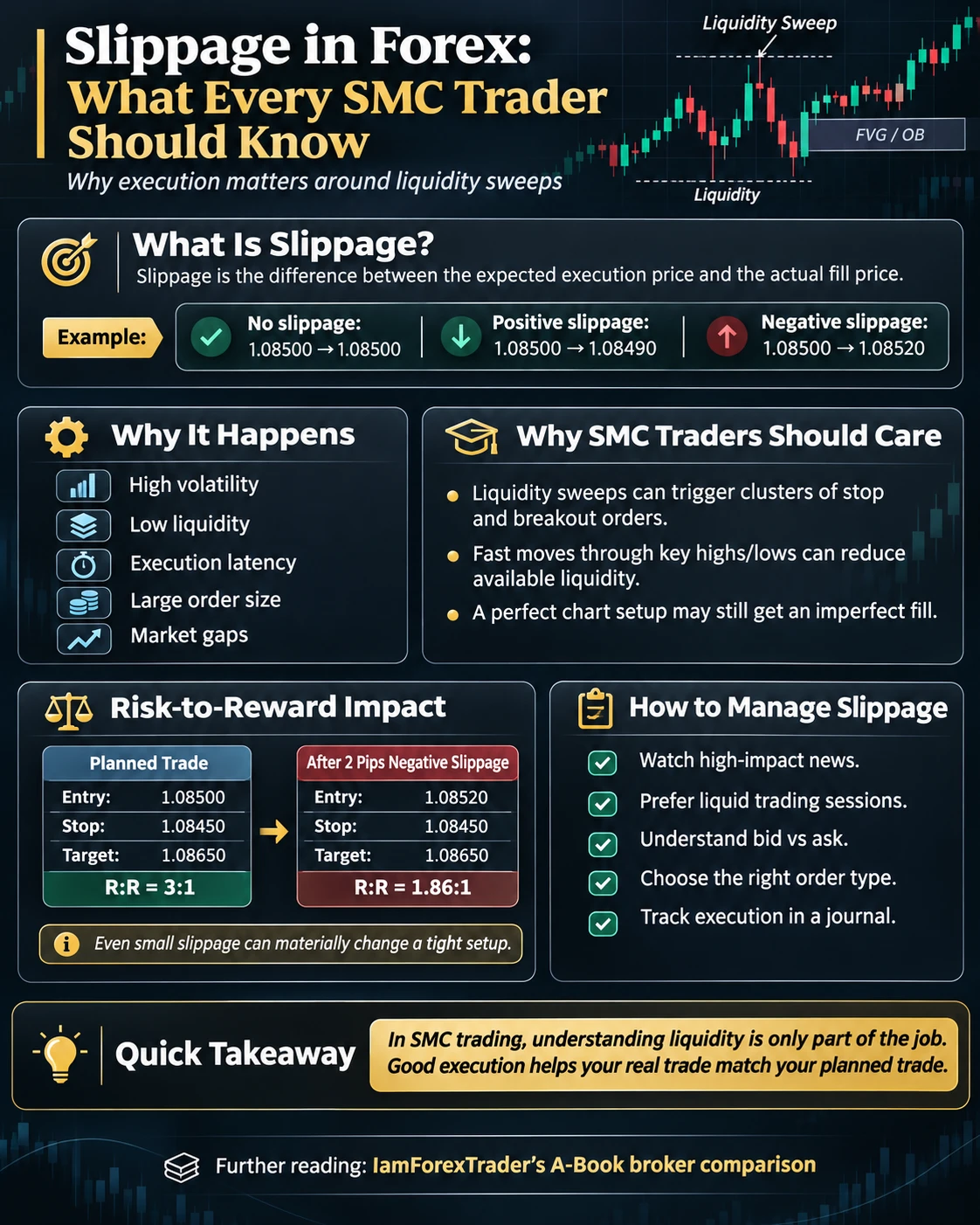
Slippage in forex is the difference between the expected execution price of a trading order and the actual price at which it is filled.
It occurs when the available market price changes before an order can be executed at the expected level.
For example, imagine placing a market buy order on EUR/USD when the quoted ask price is 1.08500. By the time your order reaches the execution system, the best available price has moved to 1.08520.
Your order is filled two pips higher than expected.
However, slippage isn’t always negative. Sometimes the market moves in your favour, allowing you to receive a better execution price.
| Type of execution | Expected buy price | Actual buy price | Result |
|---|---|---|---|
| No slippage | 1.08500 | 1.08500 | 0 pips |
| Positive slippage | 1.08500 | 1.08490 | 1 pip improvement |
| Negative slippage | 1.08500 | 1.08520 | 2 pips worse |
Both positive and negative slippage can occur under normal market conditions. Negative slippage alone is not evidence of broker manipulation.
Why Does Slippage Occur in Forex Trading?
The forex market is decentralized. Unlike a centralized stock exchange, it operates through a network of banks, financial institutions, brokers, trading venues, and liquidity providers.
Prices and available trading volumes can change rapidly.
Several factors contribute to slippage:
- High market volatility: Prices can move significantly within milliseconds, particularly during economic announcements.
- Low market liquidity: There may not be enough available volume at the requested price.
- Execution latency: Delays between submitting and processing an order can affect the final execution price.
- Large order sizes: An order may need to be executed across multiple price levels.
- Market gaps: Prices can move directly from one level to another without trading at every intermediate price.
Slippage is particularly relevant when trading market orders or stop orders during fast-moving conditions.
Why Liquidity Sweeps Can Increase Slippage
For SMC traders, liquidity is a central part of market analysis. Previous highs and lows, equal highs, equal lows, and session extremes are commonly monitored as potential areas where orders may accumulate.
When price moves through one of these levels, numerous stop and breakout orders may be triggered within a short period.
This can create a sudden imbalance between incoming orders and available liquidity.
Consider a hypothetical scenario:
- EUR/USD forms equal lows during the Asian session.
- Price breaks below those lows shortly after London opens.
- Stop-loss orders and breakout sell orders are triggered.
- Price moves rapidly through several levels before reversing.
- Traders attempting to enter during the movement may experience slippage.
This scenario illustrates why a liquidity sweep can look much cleaner on a historical chart than it feels when trading in real time.
It’s also worth remembering that a wick through an obvious liquidity level does not prove institutional manipulation or guarantee a reversal. Retail forex charts cannot reveal every order in the broader market.
A setup can be technically precise on a chart while remaining imperfect in execution. Understanding that difference is part of becoming a more disciplined trader.
How Your Broker’s Execution Model Matters
Many traders spend hours refining their entry models but very little time investigating how their orders are actually processed.
A broker’s execution model can influence how orders are handled, where pricing comes from, and how trades are matched or hedged.
Under an A-Book model, a broker generally transfers or hedges client trading exposure with external liquidity providers. Other execution models may involve internalizing some or all of that exposure.
Neither model automatically guarantees better execution. Factors such as liquidity depth, pricing arrangements, technology, and order-handling policies also matter.
Traders researching different execution environments can use IamForexTrader’s A-Book broker comparison as a starting point for evaluating regulation, trading conditions, and execution arrangements.
When reviewing a broker, pay particular attention to:
- Order execution policies and available order types.
- Transparency regarding positive and negative slippage.
- Typical spreads and commissions.
- Regulatory oversight and the legal entity serving your account.
- Execution quality during volatile market conditions.
No legitimate execution model can eliminate market-driven slippage entirely.
How Slippage Affects Your Risk-to-Reward Ratio
Slippage becomes especially important for traders who use tight stop losses and precise entries.
Suppose an SMC trader identifies a potential long setup with the following parameters:
| Trading parameter | Planned trade | Actual trade |
|---|---|---|
| Entry price | 1.08500 | 1.08520 |
| Stop loss | 1.08450 | 1.08450 |
| Take profit | 1.08650 | 1.08650 |
| Potential loss | 5 pips | 7 pips |
| Potential profit | 15 pips | 13 pips |
| Reward-to-risk ratio | 3:1 | 1.86:1 |
Just two pips of negative entry slippage increase the planned price risk by 40%, assuming the same position size.
The example excludes commissions and assumes both exit levels are executed at their specified prices. In practice, exit slippage and other trading costs can further affect the result.
For scalpers and lower-timeframe SMC traders, these differences can have a meaningful impact on long-term performance.
Market Orders vs. Limit Orders: Which Handles Slippage Better?
Choosing the right order type involves balancing execution certainty against price certainty.
| Order type | Main characteristic | Slippage considerations |
|---|---|---|
| Market order | Seeks immediate execution | May fill at a different price |
| Limit order | Specifies an acceptable price or better | Protects entry price but may remain unfilled |
| Stop order | Triggers when a specified price is reached | May experience slippage after activation |
| Stop-limit order | Activates a limit order at a trigger price | Controls execution price but may not fill |
For instance, a trader waiting for a retracement into a fair value gap might use a limit order rather than chasing a fast-moving market.
However, price certainty comes with a trade-off. A limit order may remain unfilled even when the chart appears to touch the entry level, depending on bid and ask prices and available liquidity.
Stop-limit orders also carry non-execution risk, making them unsuitable as a universal replacement for protective stop-loss orders.
Five Ways to Manage Slippage in Forex
1. Pay Attention to High-Impact News
Interest rate decisions, inflation reports, and employment data can cause rapid price movements, wider spreads, and reduced liquidity at individual price levels.
Check the economic calendar before entering trades and account for scheduled announcements in your trading plan.
2. Consider Trading Session Liquidity
Major currency pairs often benefit from deeper liquidity during active trading sessions, particularly when London and New York overlap.
However, session openings and unexpected news can still produce abrupt market movements. High trading activity does not guarantee stable execution.
3. Understand Bid and Ask Prices
A chart may display only the bid price, while a buy order is executed against the ask price.
This difference can explain why an order appears to execute at an unexpected level. Spread and slippage are related trading costs, but they are not the same thing.
Always check which price triggers your order.
4. Include Execution Costs in Backtesting
A strategy that assumes perfect entries and exits may produce unrealistic results.
When backtesting SMC setups, include reasonable assumptions for spreads, commissions, and slippage. Test how your results change under less favourable execution conditions.
A strategy that only works with perfect fills may not be robust enough for live trading.
5. Keep an Execution Journal
Your trading journal should record more than winning and losing trades.
Consider tracking:
- Requested and actual execution prices.
- Positive and negative slippage in pips.
- The spread when the order was submitted.
- Trading session and currency pair.
- Upcoming economic announcements.
- Order type and execution time.
Over a sufficiently large sample of trades, this information may reveal patterns that ordinary chart analysis misses.
For example, you might discover that your liquidity sweep setups experience higher execution costs during certain news events than during normal market conditions.
Final Thoughts
Smart Money Concepts can provide a framework for analyzing liquidity, market structure, and potential trading opportunities. However, identifying a promising setup is only one part of the trading process.
Execution quality determines how closely your actual trade matches the one you planned.
By understanding slippage, choosing suitable order types, monitoring trading conditions, and recording real execution data, traders can develop a more realistic picture of their strategies.
The goal isn’t to eliminate every unexpected price movement. That’s impossible. It’s to build a trading approach that accounts for imperfect execution rather than depending on ideal market conditions.
Remember that leveraged forex trading involves substantial risk, and no trading strategy or execution model guarantees profitability.