
ONDO is the governance token of Ondo Finance, the largest real-world asset tokenization protocol by TVL. The token gives holders voting rights over protocol parameters, treasury decisions, and product direction through the ONDO DAO. That governance utility is currently the primary function of the token, and understanding both why that matters and why it creates a tension with price performance is essential before forming any view on the project.
The products Ondo builds are not governance tokens or speculative instruments. They are tokenized versions of regulated financial assets: short-term U.S. Treasuries, money market fund exposure, and now tokenized equities and ETFs. These are products that generate real yield from real-world cash flows, and that yield goes to the product holders, not to ONDO token holders. The disconnect between platform performance and token performance is the central question anyone researching ONDO needs to sit with honestly.
The Ondo Finance Platform: Three Products Worth Understanding in Depth
USDY is the most accessible product Ondo offers. It is a yield-bearing token backed by short-term U.S. Treasuries and bank demand deposits, structured to comply with U.S. securities regulations. Unlike most stablecoins, which hold a dollar peg but offer no return, USDY uses an accumulating price mechanism where the token itself appreciates as yield accrues. Holding USDY generates a return tied to prevailing Treasury rates without requiring any active management. The permissionless structure makes it the entry point for non-institutional users who want real-world yield on-chain, and the CoinGecko 2025 RWA Report identified USDY as one of a small group of instruments that genuinely blend stablecoin liquidity with real-world cash flows rather than synthetic approximations.
OUSG is the institutional layer. It provides tokenized exposure to short-term U.S. Treasury bills and government money market funds, backed by a diversified portfolio managed by BlackRock through its BUIDL fund, Franklin Templeton, Fidelity, WisdomTree, and Wellington Management. The product is structured as interests in a 3(c)(7) fund under Regulation D Rule 506(c), which means it is available only to accredited and qualified investors. The minimum entry is $5,000, with 0% mint and redeem fees and management expenses capped at 0.15%. OUSG reached around $692 million in TVL by January 2026 and supports 24/7 instant minting and redemption via USDC, which is a meaningful operational advantage over traditional money market fund access that operates on banking hours.
Ondo Global Markets launched in September 2025 and is the product that extends the Ondo thesis from fixed income into equity markets. It tokenizes over 200 U.S. stocks and ETFs, including major technology companies, SPY tracking the S&P 500, and QQQ tracking the Nasdaq 100. Assets are backed 1:1 by traditional securities and settle on blockchain rails while sourcing liquidity from major U.S. exchanges rather than on-chain pools. This means pricing is at brokerage level with near-zero slippage for trades up to million-dollar size. The January 2026 expansion brought these products to Solana, making Ondo Global Markets the largest RWA issuer on Solana by asset count and opening access to the 3.2 million daily active users on that network. The tokenized equities market reached approximately $963 million in value as of January 2026, a 2,900% increase year on year from $32 million, and Ondo is a primary driver of that growth.
The TVL Trajectory: What the Numbers Actually Show
Ondo’s TVL growth over the past two years is one of the most consistent in DeFi regardless of category. TVL jumped from $40 million to over $534 million in 2024. By mid-September 2025, it reached $1.6 billion. By early April 2026, it crossed $3 billion, reaching approximately $3.015 billion on April 9, following an 8% increase from roughly $2.79 billion at the start of that month. That growth reflects sustained net inflows of capital from institutional and retail participants rather than price appreciation in underlying assets. When TVL grows through inflows rather than asset price appreciation, it signals genuine demand for the product.
The cumulative trading volume milestone is equally significant. Ondo Global Markets recorded over $6.8 billion in cumulative trading volume since its September 2025 launch through early 2026. The platform processed over $7 billion in total cumulative volume across products. These are not DeFi-native volume figures driven by token incentives or liquidity mining. They reflect real transactions from users who wanted access to Treasury yield and tokenized equities through blockchain infrastructure.
The 404% year-over-year TVL growth in early 2026 and the 31% monthly increase during the same period were happening simultaneously with a 12.9% monthly decline in the ONDO token price. That divergence between platform metrics and token price is exactly the tension that anyone evaluating ONDO needs to understand before making a position decision.
Team and Regulatory Milestones: Why This Is Not a Typical Crypto Team
Nathan Allman founded Ondo after working at Goldman Sachs in the digital assets division, where he developed experience in structured finance and asset management. Justin Schmidt serves as President with the same Goldman Sachs background. Chief Strategy Officer Ian De Bode is a former McKinsey partner. Katie Wheeler joined from BlackRock. In September 2025, Ondo appointed Peter Curley as Head of Global Regulatory Affairs and Global Head of Compliance. Curley’s background spans the U.S. Securities and Exchange Commission, the U.S. Department of the Treasury, and Coinbase. Former House Financial Services Committee Chair Patrick McHenry joined the advisory board in the same period.
The regulatory story around Ondo in 2025 is as important as the product story. The SEC formally closed its investigation into Ondo in November 2025 without recommending charges. This removed a material overhang that had been creating uncertainty for institutional capital considering exposure to the platform. Following that closure, Ondo accelerated its U.S. operations and completed the integration of Oasis Pro Markets, an SEC-registered broker-dealer. The Oasis Pro acquisition alongside the earlier Strangelove acquisition in July 2025 gave Ondo a full-stack solution: blockchain infrastructure through Strangelove and licensed securities trading through Oasis Pro.
The 21Shares Ondo Trust ETF filing in July 2025 is the most significant pending catalyst for ONDO token demand. If approved by the SEC, it would allow traditional investors to gain ONDO exposure without navigating crypto infrastructure, opening a potential capital pathway that has not existed for most DeFi governance tokens. SEC Chair Paul Atkins hinted at an innovation exemption for on-chain securities trading in April 2026, which would further reduce the compliance friction that has limited some institutional participants from engaging directly with tokenised products.
The SWEEP fund, a collaboration with State Street and Galaxy Asset Management with $200 million in seed capital, is scheduled to launch in 2026. BlackRock and J.P. Morgan are both cited as institutional validation partners in custody and settlement arrangements. Mastercard integration is also live, extending the reach of tokenised products into payment rail contexts.
The Ondo Chain: Building Dedicated Infrastructure for Institutional RWAs
Ondo Chain is the longest-horizon product in the roadmap, a dedicated Layer-1 blockchain designed specifically for institutional RWA settlement with native proof-of-reserves oracles. The mainnet is targeted for 2026. The strategic logic is that general-purpose public blockchains were not designed for the specific compliance, settlement, and reporting requirements that institutional capital management demands. A dedicated Layer-1 with those requirements built into the base protocol rather than layered on top as smart contracts creates meaningfully better guarantees for institutional participants.
PancakeSwap integration on BNB Chain already brought over 260 Ondo RWA products to retail DeFi users. The multi-chain footprint spans Ethereum as the primary settlement layer, BNB Chain, Solana, Injective, and others via the Ondo Bridge built on LayerZero’s cross-chain protocol. Ondo Perps, released in smart contract form in March 2026, enables on-chain equity perpetual futures with novel collateral options, extending the product suite beyond spot tokenised assets into derivatives.
The ONDO Token: What Governance Actually Means Here
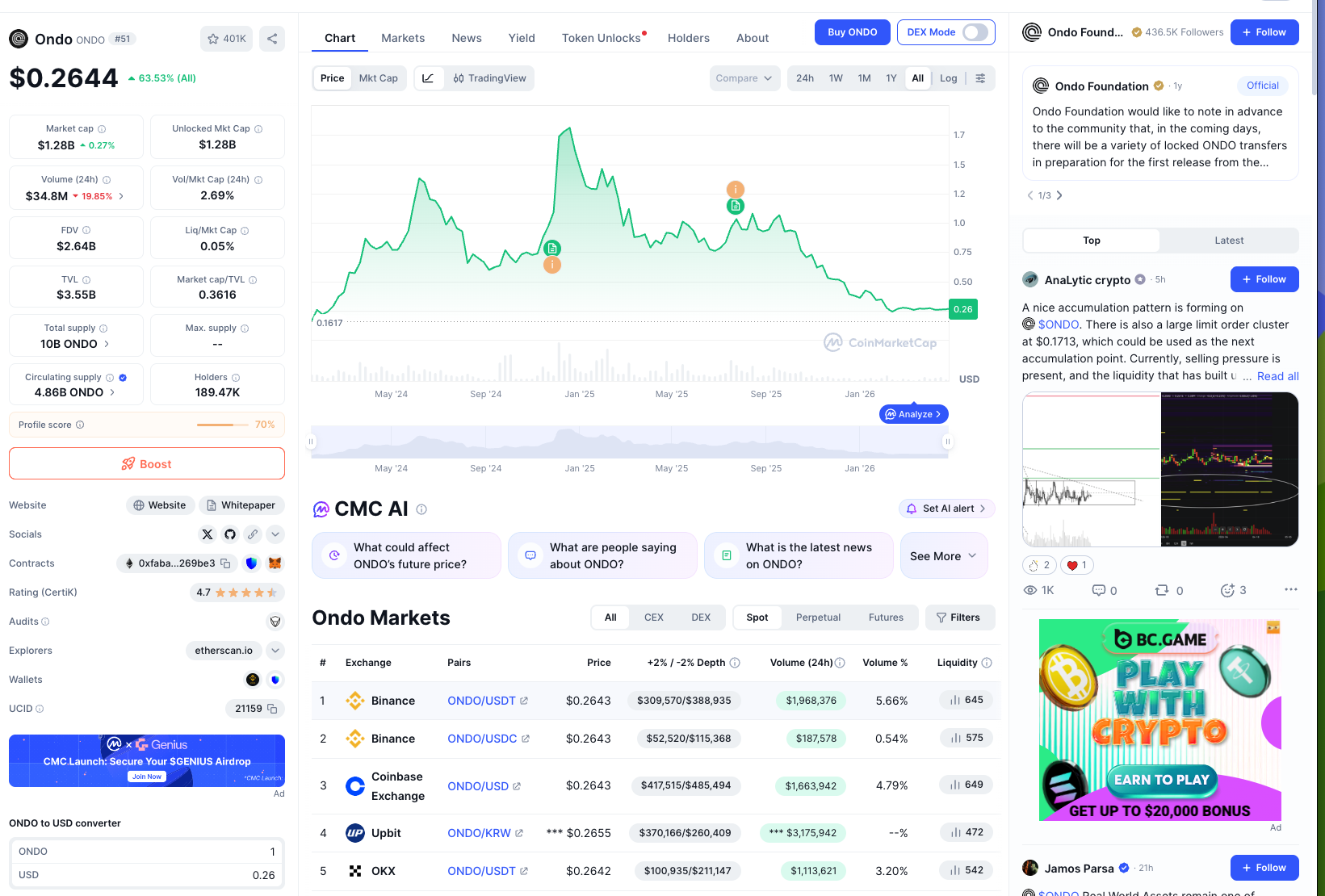
The honest assessment of ONDO token utility requires acknowledging what it does not do as clearly as what it does. Protocol revenue from fees and spreads on tokenised products does not flow heavily to ONDO holders through burns or revenue sharing. The token is primarily governance-focused, giving holders votes on protocol parameters, treasury allocation, and product direction.
For some investors, governance participation in a protocol managing $3 billion in institutional assets is meaningful in itself. Decisions made through the ONDO DAO affect how that capital is deployed, what products are built, and how the protocol evolves. For others, the lack of direct revenue accrual to the token means the investment thesis is entirely dependent on the future market assigning a higher governance premium to the token as the RWA market grows.
One community analyst framed it clearly: ONDO is in a temporary position where it is too real for meme trading but too early for business-like pricing where governance utility commands a premium. Whether that gap closes depends on whether direct utility features like staking and fee-sharing are introduced and whether the platform’s institutional growth eventually forces the market to assign value to governance rights over a multi-billion dollar asset management protocol.
Token Unlock Pressure: The Dominant Near-Term Risk
ONDO has a maximum supply of 10 billion tokens. The January 2026 unlock increased circulating supply by approximately 61%, creating a structural supply overhang that analysts have identified as the most pressing headwind for price recovery. Early investor wallets have been flagged by on-chain analysts as transferring large ONDO batches to exchanges, signalling ongoing sell-side pressure.
The historical pattern from the January 2025 unlock is instructive: the unlock triggered approximately a 10% price drop before the token eventually recovered. Whether the January 2026 unlock follows a similar trajectory or leads to a more sustained period of price suppression depends on whether demand from new institutional adoption, potential ETF flows, and governance participation can absorb the additional supply.
Circulating supply is approximately 4.87 billion tokens as of late April 2026. The gap between circulating and maximum supply means future unlock events will continue to be a recurring factor in the supply-demand balance for the foreseeable future. Always check Tokenomist for the current unlock schedule before making a position decision.
Key Risks: What the Data Requires You to Acknowledge
The value accrual problem is structural until changed by governance. If ONDO token holders never receive a meaningful share of protocol revenue, the investment thesis is entirely dependent on governance premium expansion as TVL grows. That can work, but it requires a level of market maturity around RWA governance tokens that does not yet exist.
Regulatory risk in tokenised assets is two-directional. The SEC investigation closure was a positive development, but tokenised securities face evolving rules across multiple jurisdictions. Cross-border compliance for products like Ondo Global Markets creates ongoing legal complexity in markets where the regulatory framework for blockchain-native securities has not yet been fully established.
Competition is intensifying. Securitize holds approximately 42% market share in tokenised Treasuries. Franklin Templeton, BlackRock, and Fidelity are all moving deeper into tokenised asset products with their own native infrastructure. Ondo’s first-mover advantage in permissionless RWA access is real, but it is not permanent.
Smart contract risk is present across any DeFi infrastructure. The RWA sector recorded $14.6 million in losses from exploits in the first half of 2025, which demonstrates that technical risk is not eliminated by institutional backing.
Getting Started with Ondo Finance
Visit ondo.finance to explore USDY and OUSG if you want direct exposure to the yield products rather than the governance token. USDY is the permissionless entry point requiring no accreditation. OUSG requires qualified investor verification with a $5,000 minimum. For ONDO governance participation, review current DAO proposals before making any allocation to understand what decisions are actively being made and whether your involvement would be meaningful. Check Tokenomist for the current unlock schedule. Monitor TVL growth, monthly transfer volumes, and Ondo Chain mainnet progress as the primary leading indicators of whether institutional adoption is continuing to accelerate.
Ondo Finance is one of the most institutionally credible projects in crypto by almost any measure: the team’s background, the regulatory milestones, the partnership quality, and the product architecture. The tension between that institutional credibility and the ONDO token’s price performance is the honest story here. Whether that tension resolves in favour of token holders depends on governance premium expansion, potential revenue sharing, and whether the 21Shares ETF filing clears the SEC. Those are real catalysts with real uncertainty attached to them.
This article is for educational purposes only and does not constitute financial advice. Always conduct your own research before making any investment decisions. Only invest what you can afford to lose completely.
